
LZH Develops 3D Printing for Steel Structures in the Sea
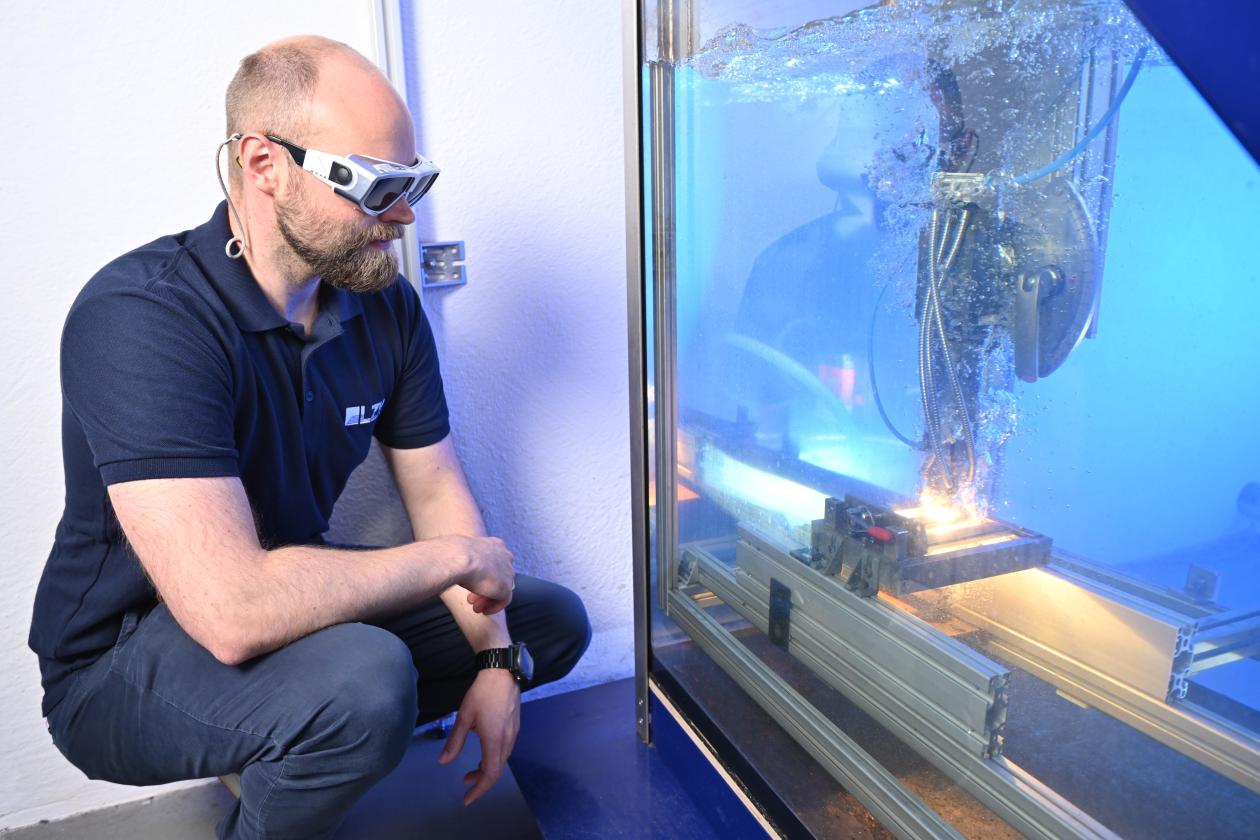
Underwater structures such as offshore wind turbines, bridge piers, or port infrastructure are exposed to extreme conditions. Repairing damage to their steel structures is complex and expensive. In the “RoLaKI” project, LZH, the Institute of Information Processing (TNT) at Leibniz University Hannover, and OFTEC Handelsgesellschaft für Oberflächentechnik mbH are working on a solution: they are developing a process that allows steel structures to be coated over large areas underwater or repaired by “printing on” new structures.
Laser and AI Work Together
At the core of the project is laser-based 3D printing underwater. The researchers first investigate how various process parameters influence layer formation and the processing result. Using this data, they then train an artificial intelligence (AI) that learns autonomously and predicts optimal parameters for new repair tasks. In addition, they aim to design an AI-supported path planning system that calculates the best way to repair a damaged area.
Special Technology for Use Underwater
For use outside the laboratory, the team is developing a special laser processing optic. This will combine the optical components with the wire feed used in the coating process. The optic will be mounted on a fine positioning system attached to a magnetic crawler that transports the system underwater to the damaged site. This fine positioning system makes it possible to build weld seams precisely next to and on top of each other. By the end of the project, the partners aim to demonstrate the entire process using a prototype.
About RoLaKI
The German Federal Ministry of Research, Technology and Space (BMFTR) is funding the joint project “Robot- and Laser-Based 3D Printing with AI Support for the Sustainable Repair of Underwater Steel Structures – RoLaKI” as part of the funding measure “Digital GreenTech – Environmental Technology Meets Robotics”, within the framework of the BMFTR strategy “Research for Sustainability (FONA).” The accompanying project “BRIDGE” supports the funded collaborative projects of the “Digital GreenTech” initiative with comprehensive legal and ethical expertise.

Laser Zentrum Hannover e.V. (LZH)
As an independent, non-profit research institute, the Laser Zentrum Hannover e.V. (LZH) stands for innovative research, development, and consulting. Supported by the Lower Saxony Ministry of Economics, Transport and Building, the LZH is dedicated to selflessly promoting applied research in the field of photonics and laser technology. Founded in 1986, almost 200 employees are now working at the LZH.
The LZH offers solutions to current and future challenges with its smart photonics. Along the process chain, natural scientists and engineers work interdisciplinary together: from component development for specific laser systems or for quantum technologies to process developments for a wide variety of laser applications, for example for medical and agricultural technology or lightweight construction in the automotive sector. 18 successful spin-offs have emerged from the LZH to date. Thus, the LZH creates a strong transfer between fundamental science, application-oriented research, and industry - and uses light for innovation.