Laser under water
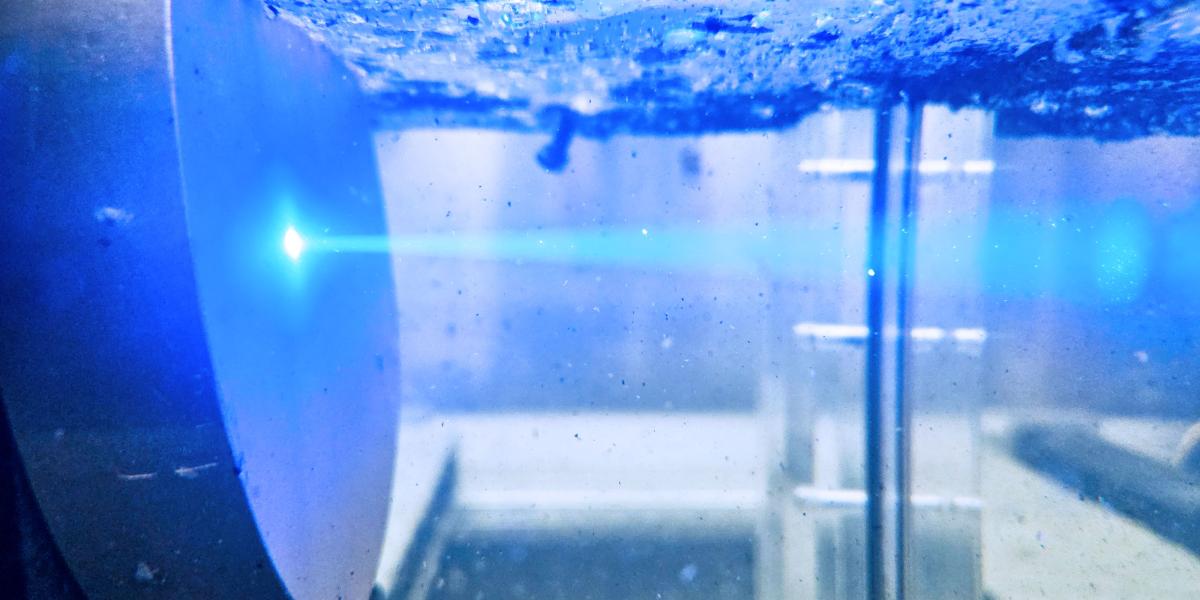
We develop processes and system technology for underwater applications. We specialise in underwater cutting and welding, with the aim of automating processes and reducing the burden on divers, or providing them with support. In the field of Additive Manufacturing, we are researching the use of this technology for repairing or rebuilding components underwater. We are also working on the automated, safe defusing of unexploded ordnance from the First and Second World Wars on the ocean floor. We also focus on removing biofilm and fouling from ship hulls and aquaculture systems.
Dr.-Ing. Benjamin Emde


Videos of projects and processes
Process Video: Treatment of Underwater Fouling
The system developed by LZH uses a curtain of blue laser radiation to sustainably damage biofouling. After treatment, the growth is washed away by the current. The laser was developed by Laserline. Fraunhofer IFAM handles the optimization of anti-fouling coatings, while OFTEC Handelsgesellschaft für Oberflächentechnik mbH is developing a magnetic crawler that allows the laser to be guided along the ship's hull.
Cutting sheet piles underwater
Underwater work is complex. Therefore, the Laser Zentrum Hannover e.V. (LZH) and the Institute of Materials Science at Leibniz Universität Hannover have developed a laser process to automatically cut sheet pilings underwater. However, if they are to be dismantled, divers have to disassemble them with a cutting torch. Typically, a diver manages to cut about 20 meters per day, which corresponds to a speed of 0.07 m/min. In the LuWaPro project, the LZH has developed a process in which a disk laser makes the cuts in the torch cut. As a result, the diver now only performs a control function.
Animation: Removing underwater biofouling
Marine fouling on ship hulls is a significant problem for the industry. This so-called biofouling increases flow resistance and thus fuel consumption and emitted emissions. Therefore, the Laser Zentrum Hannover e.V. (LZH), Laserline GmbH, and the Fraunhofer Institute for Manufacturing Technology and Applied Materials Research (IFAM) want to develop a laser-based cleaning process to gently and efficiently remove the fouling without damaging the underlying coating.
Innovative underwater deep-sea analysis
Rare metals are deposited on the ocean floor. These are needed for modern technologies but have been difficult to discover until now. The laser-induced plasma spectroscopy system from LZH and Leibniz Institute for Plasma Science and Technology e.V. offers a new environmentally friendly analysis method for the deep sea.
Locating mineral resources on the seafloor
Locating mineral resources on the ocean floor has traditionally involved very high costs. Laser Zentrum Hannover e.V. (LZH), together with eight partners in the EU project ROBUST, has developed a laser-based analysis system to examine seafloor samples in the deep sea with minimal destruction. The laser-induced breakdown spectroscopy (LIBS) system enables near-nondestructive analysis of material samples to determine their atomic composition. The LIBS system developed by LZH successfully withstood pressures of 400 bar during practical tests in the deep sea.