
Detecting food fraud with quantum sensing
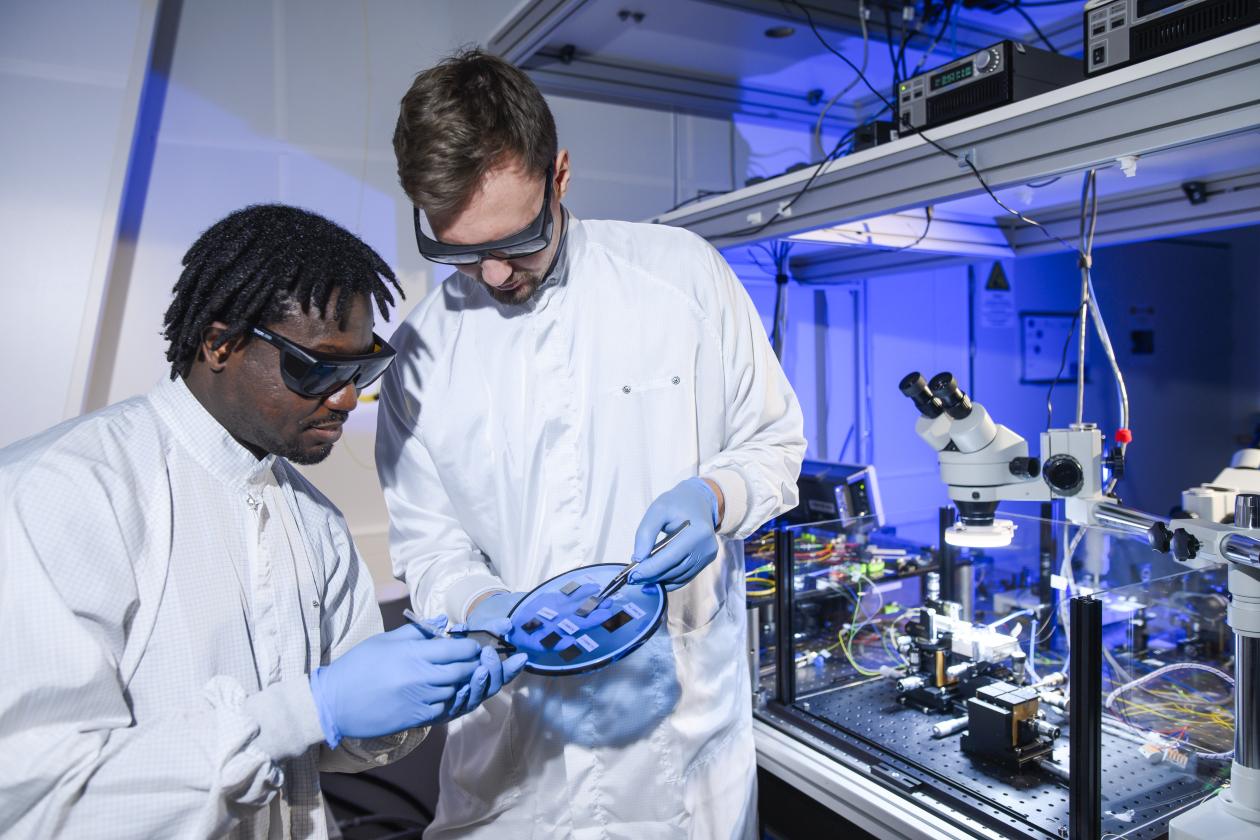
Food fraud causes billions in damages every year and can pose serious health risks. Common examples include honey adulterated with sugar water, orange juice or tequila diluted with cheaper ingredients. To date, verifying the authenticity of food products requires laboratory analysis — a process that is complex, costly, and time-consuming. The BMFTR-funded project QSPEC addresses this challenge by developing a quantum-based spectroscopy method that is significantly more compact and cost-effective than existing techniques. The primary focus is on honey and orange juice, which rank among the most frequently adulterated food products according to the Journal of Food Science. The six partners AMO GmbH, the Photonic Quantum Technologies research group at Leibniz University Hannover (LUH), TOPTICA Photonics SE, AMOtronics UG, the German Institute of Food Technologies (DIL), and Laser Zentrum Hannover e.V. (LZH) are jointly developing a system comprising a laser, quantum-optical components, and the associated detection hardware.
Exploiting wavelength differences in photon pairs
The spectroscopy method is based on the use of entangled photon pairs for measurement. The long-wavelength photon interacts with the sample and modifies its properties; this change is then transferred to a short-wavelength photon in a second step. The researchers use the complementary characteristics of the two wavelengths within the photon pair: the long-wavelength photon interacts more effectively with the sample, while the short-wavelength photon is easier to detect.
Laser sources for entangled photon generation
TOPTICA SE and LZH have completed two key building blocks: novel laser sources for generating entangled photons using a quantum frequency comb. Each partner has delivered a distinct laser design to LUH. Both lasers emit at a wavelength of 1,950 nm and feature a very narrow spectral linewidth of less than 1 GHz, as required for pumping the quantum frequency comb. The two sources differ in their pulse characteristics. The LZH laser operates in the picosecond regime, while the TOPTICA laser emits in continuous-wave (cw) mode and is mode-hop-free tunable from 1,920 nm to 1,980 nm.
Successful generation of entangled photon pairs
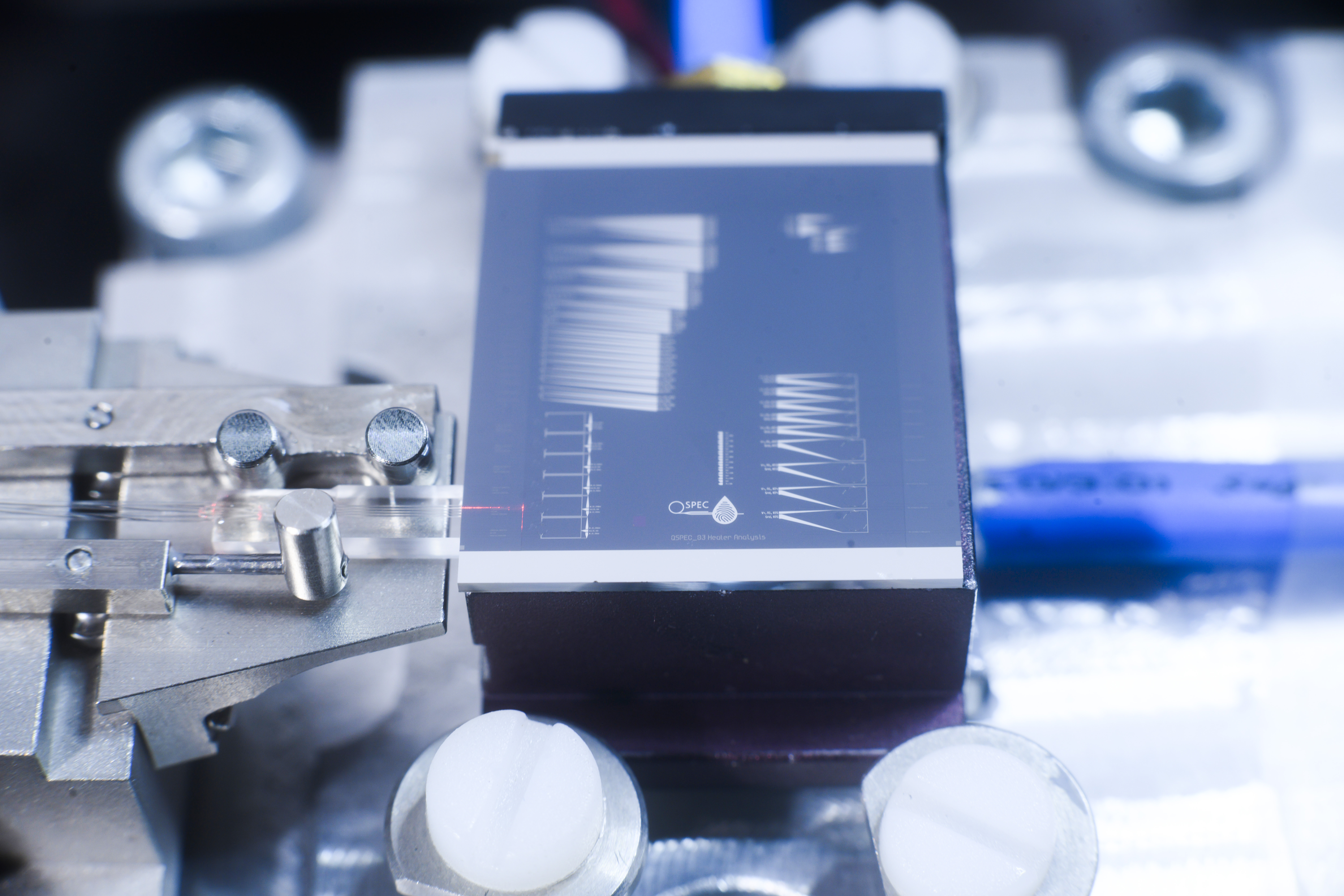
In parallel, AMO GmbH has fabricated the first nanophotonic chips for the project. These chips integrate the essential components required for the measurement — including those needed for generating quantum frequency combs with the TOPTICA and LZH lasers — into an extremely compact form factor. Using chips manufactured by AMO, LUH has already demonstrated the generation of photon pairs at a wavelength of 1,550 nm – an important first milestone on the path towards a quantum-based measurement principle.
System for temperature stabilization
Stable temperature conditions are critical to ensuring that the precisely matched individual components deliver reproducible results under the demanding conditions of quantum measurements. To address this, AMOtronics UG has built a dedicated temperature stabilization system. A key feature of this system is its modular architecture, which enables straightforward, independent digital precision control (PID) and monitoring of temperature across up to eight channels. In addition to a graphical user interface, the system offers a programmable software interface for flexible integration into more complex setups.
Reference database for orange juice and honey
In the next project phase, the partners will continue developing the laboratory system and convert it into a first compact prototype. Using this system, the DIL will test food samples against established reference methods. The institute is building a reference database using standard techniques such as NIR and NMR spectroscopy as benchmark for later validation. Orange juice and honey are the first food samples under investigation. With the prototype the researchers will then perform comparative measurements to assess and refine its analytical performance. This will expand the database and ultimately enable conclusions about the origin and composition of food products — with advantages in speed, accuracy, and ease of use compared to current methods.
The project partners aim to lay the groundwork for an industrial system that is small and affordable enough for widespread deployment. Their long-term vision is to integrate this functionality directly into a smartphone — so that everyone can know exactly what is in their food.
About QSPEC
The QSPEC project is funded by the German Federal Ministry for Research, Technology and Space (BMFTR) under the funding initiative "Lighthouse Projects in Quantum-Based Metrology for Addressing Societal Challenges." The consortium coordinator is AMO GmbH. Further partners include Laser Zentrum Hannover e.V. (LZH), the Photonic Quantum Technologies research group at Leibniz University Hannover (LUH), TOPTICA SE, AMOtronics UG, and DIL Deutsches Institut für Lebensmitteltechnik e.V. Associated partners are AIRSENSE Analytics GmbH, J&M Analytik, VPIphotonics GmbH, and Food Processing Initiative e.V.


Laser Zentrum Hannover e.V. (LZH)
As an independent, non-profit research institute, the Laser Zentrum Hannover e.V. (LZH) stands for innovative research, development, and consulting. Supported by the Lower Saxony Ministry of Economics, Transport and Building, the LZH is dedicated to selflessly promoting applied research in the field of photonics and laser technology. Founded in 1986, almost 200 employees are now working at the LZH.
The LZH offers solutions to current and future challenges with its smart photonics. Along the process chain, natural scientists and engineers work interdisciplinary together: from component development for specific laser systems or for quantum technologies to process developments for a wide variety of laser applications, for example for medical and agricultural technology or lightweight construction in the automotive sector. 18 successful spin-offs have emerged from the LZH to date. Thus, the LZH creates a strong transfer between fundamental science, application-oriented research, and industry - and uses light for innovation.