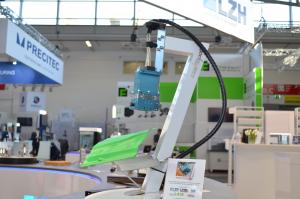
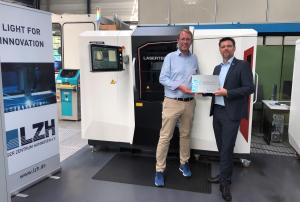
At LASYS 2022, the LZH will present innovations in smart photonics from the fields of smart production, smart additive, and smart agricultural technologies from June 21 to 23.
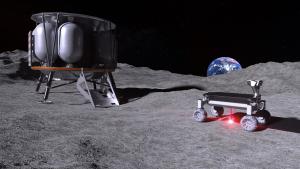
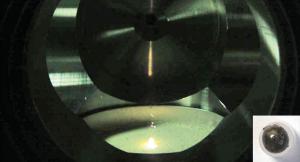
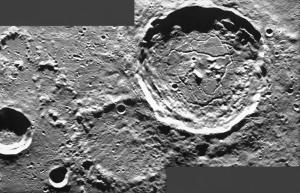
3D printing on the Moon: Scientists from the Laser Zentrum Hannover e.V. (LZH) and the Technische Universität Berlin (TU Berlin) are planning a flight to the Moon to melt lunar dust with laser radiation.
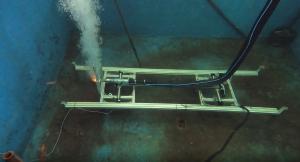
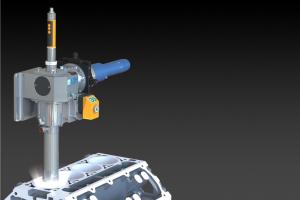
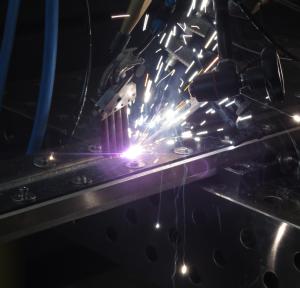
The LZH, together with an industrial partner, is developing a laser-assisted metal flux-cored welding process for use underwater. The process aims to facilitate welding work underwater and produce better weld seams.
Digitization of production? The laser makes it possible! At this year's Hannover Messe, the LZH presents smart laser-based solutions, not only for agriculture. Also: services for companies from Lower Saxony with an interest in 3D printing.
The LZH will be attending LASER World of PHOTONICS from April 26 to 29, 2022 in hall A5 at stand 210. There, the institute will present smart photonics: forward-looking, digital, and intelligent approaches to laser technology and photonics for the challenges of tomorrow.
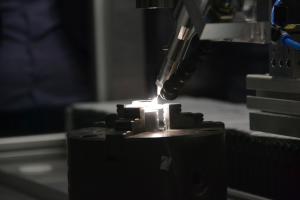
Welding brass is used for many components, but welding copper alloy is challenging. In the LaserMessing project, LZH and LMB Automation GmbH are developing a laser-based production system for the automated production of brass components.
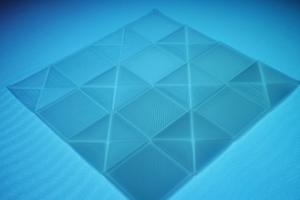
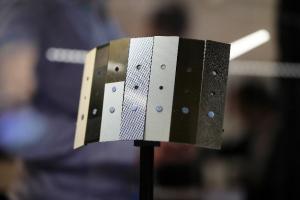
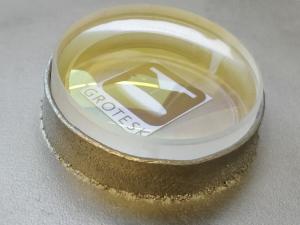
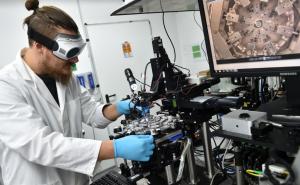
With a new Spatial ALD system, the LZH can now also uniformly coat complex-shaped optics. The innovative system achieves higher deposition rates than previously possible - and is of interest, among others, for applications in the automotive lighting or VR/AR sectors.
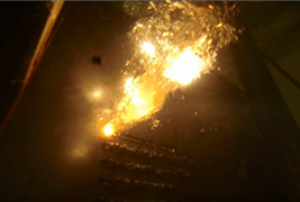
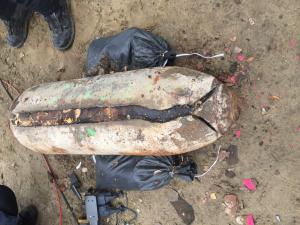
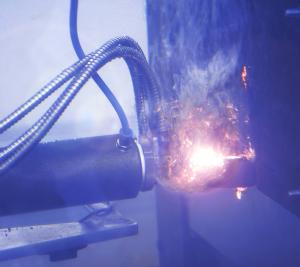
Together with project partners, the LZH is developing a process to defuse world war ammunition under water using a laser. The goal: to affect the ecosystem as little as possible while saving time and costs.
Scientists of the LZH have developed a laser to detect water in the polar regions of the Moon. Used in the project partners' measuring instrument, the system has already been successfully tested on regolith samples.
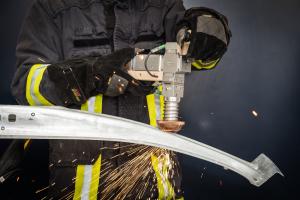
With a new type of welding head with nine individual laser spots, thermoplastics can be joined to thermoplastics and thermoplastics to metal over large areas. The LZH developed equipment and process together with six partners.
Smart photonics is trend-setting, digital, intelligent. The Laser Zentrum Hannover e.V. (LZH) is from now on bundling the topics of the future in the areas of photonics and laser technology in eight “innovation fields”.
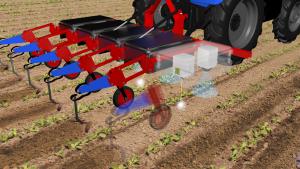
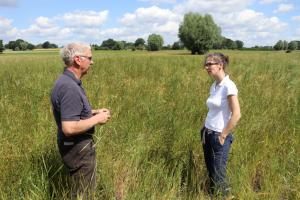
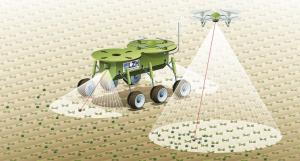
Sugarbeet has a hard time asserting itself against weeds in the field. That's why various partners have joined forces in the project LUM to develop a method for controlling weeds using hoes and lasers for an automated and sustainable weed control.
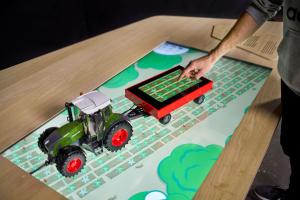
At the Expo World Exhibition in Dubai, the Laser Zentrum Hannover e.V. is present as a provider of ideas with an exhibit in the German pavilion. The interactive game "Food Farming Laser" by the agency facts and fiction GmbH is designed to introduce visitors to sustainable laser-based agricultural technology.
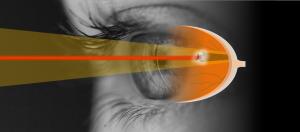
In eye surgery for cataract, the lens refilling method could allow to maintain or restore the lens's accommodation of the lens, i.e. the ability to adjust its refractive power flexibly. So far, however, this method has not yet been clinically successful. The Laser Zentrum Hannover e.V. (LZH) is now working within a new research project with ROWIAK GmbH to advance the method further.
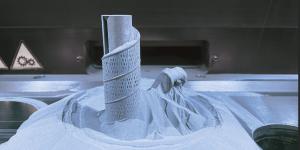
Welding 3D-printed components with the laser: This is the goal of the scientists at the Institute for Integrated Production Hannover (IPH) gGmbH and the Laser Zentrum Hanno-ver e.V. (LZH). In the new research project "QualLa", they want to develop an expert system that supports small and medium-sized enterprises in optimizing additive manufac-turing processes – so that the printed components can subsequently be welded soundly with the laser.
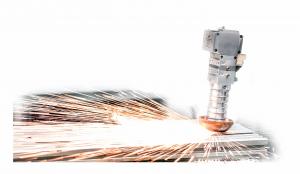
More and more nuclear power plants are reaching their maximum service life or are decommissioned due to the nuclear phase-out. To reduce the additional effort of water filtration during dismantling, scientists at the Laser Zentrum Hannover e.V. (LZH) have developed and validated a laser-based cutting process. With this method, up to 95 percent less radioactively contaminated secondary waste is released into the water when the reactor vessel internals are cut.
Up to now, oscillator free-electron lasers have only reached emission wavelengths down to 176.4 nanometers. Scientists at Laser Zentrum Hannover e.V. (LZH) have now succeeded in producing optics that allowed physicists at Duke University, USA, to generate wavelength below 170 nanometers.
Instead of using chemical products, in the future, the growth center of weeds is to be lethally damaged through laser radiation. The partners in the EU project WeLASER want to create the basis for this vision. The project brings together research institutions, companies, and non-governmental organizations (NGOs) from the agricultural sector in eight EU countries, including the Laser Zentrum Hannover e.V. (LZH). Over the next three years, the partners want to test a laser system's effectiveness on selected crops.
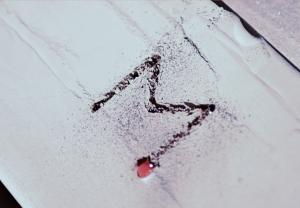
They are not yet usable as building blocks – but the lanes melted with the laser are a first step towards 3D-printed buildings, landing points, and roads made of moon dust.
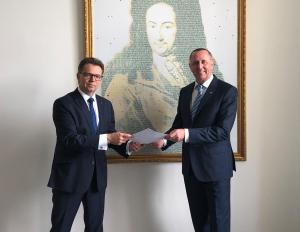
Prof. Dr.-Ing. Ludger Overmeyer, member of the Board of Directors of the Laser Zentrum Hannover e.V. (LZH) and Chairman of the Scientific Directorate, has assumed the presidency of the German Scientific Laser Society (WLT) as of January 1st, 2021.
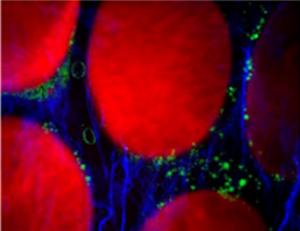
Improving the detection of cancerous cells during surgery – this is the goal of the European research project CARMEN. The research institutes Laser Zentrum Hannover e.V. (LZH) from Germany and Multitel asbl from Belgium work together with companies from both countries, JenLab GmbH, DELTATEC, and LaserSpec, to develop a novel, compact and multimodal imaging system. This could even allow the examination of tissue samples directly during surgery.
When hip prostheses are replaced, the old bone cement in the femur must first be removed – a complicated procedure. The Laser Zentrum Hannover e.V. (LZH) is developing an endoscope-based laser system with which doctors should be able to remove the old cement more gently and with an improved vision.
Grasses such as slender meadow foxtail and windgrass have become an acute problem on agricultural land. In the event of severe infestation, farmers are threatened with having to take agricultural fields out of production altogether. To develop alternatives in the fight against weeds and herbicide resistance, the Laser Zentrum Hannover e.V. (LZH) is now testing a laser-based approach for its practicality.
The spheres appear inconspicuous – but they are unique. They consist of moon dust, molten under moon gravity in the course of the MOONRISE project. The Laser Zentrum Hannover e.V. (LZH) together with the Institute of Space Systems (IRAS) of the Technical University of Braunschweig carried out this unique experiment in the Einstein-Elevator of the Hannover Institute of Technology (HITec) of the Leibniz University Hannover (LUH).
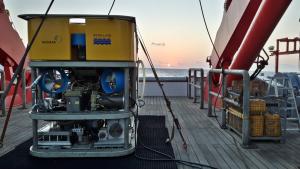
Localizing mineral resources on the sea floor has so far been associated with very high costs. In the EU project ROBUST, the Laser Zentrum Hannover e.V. (LZH), together with eight other partners, developed a laser-based analysis system to examine soil samples in the deep sea almost non-destructively. The system has passed initial practical tests.
Can laser beam cutting underwater be used for efficient reactor dismantling? This question will be investigated by scientists of the Laser Zentrum Hannover e.V. (LZH) within the scope of the AZULa project. In a feasibility study, they develop a laser beam cutting process and construct a compact cutting head for use in a radiologically activated and contaminated underwater environment.