
Quality assurance for 3D cell models
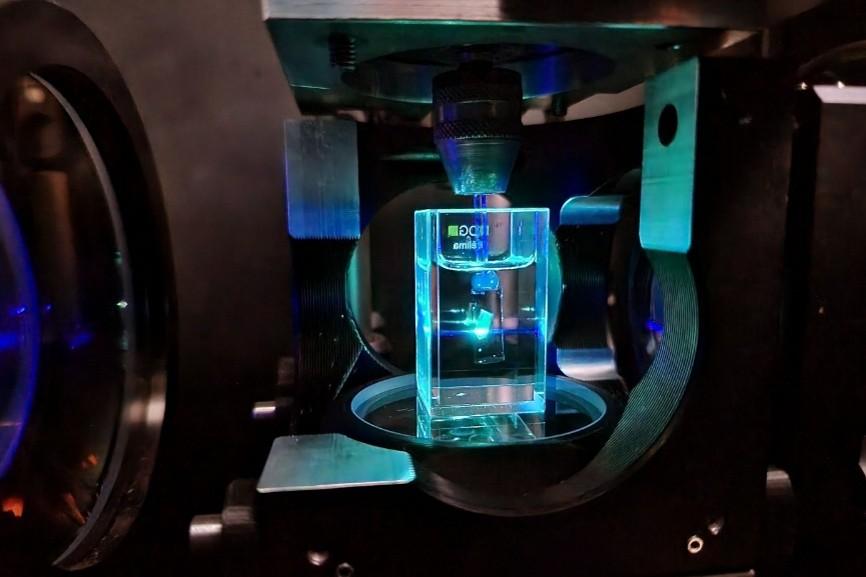
Cell spheroids and organoids are three-dimensional cell cultures that replicate human tissue far more accurately than conventional two-dimensional cell cultures. This makes them particularly attractive to the pharmaceutical industry, as they promise more precise insights into how active substances behave in the human body. However, deploying these models at an industrial scale requires reliable quality control methods - ones that leave sensitive samples intact while also supporting high throughput rates.
Three-dimensional imaging without sample damage
Scanning Laser Optical Tomography (SLOT) meets these requirements: it generates three-dimensional images of cell and tissue models in the micro- to millimeter range without causing any damage to the sample. The architecture of SLOT supports multiple contrast mechanisms - including transmission, fluorescence, and scattered light - setting it apart from other 3D imaging systems such as light sheet microscopy. It also achieves exceptionally high sensitivity, enabling SLOT to detect even weak fluorescence signals from endogenous markers without the need for additional staining. Thanks to its modular design, SLOT is more cost-effective than many commercial systems.
From laboratory system to user-friendly demonstrator
Within the AutoSphere project, the LZH team advanced SLOT from a laboratory prototype to a field-ready demonstrator. The system can now examine smaller samples, measurements are more highly automated, and operation has been significantly simplified. Practical trials confirm that users without specialist optical knowledge can successfully operate the system. The researchers also integrated AI-based algorithms to enhance image resolution in post-processing.
In parallel, an optical monitoring system was developed for cultivating cell models in ultrasonic bioreactors at consortium partners InSCREENex GmbH and OSPIN GmbH. The system automatically detects the formation of cell clusters, enabling rapid adjustment of culture conditions. Initial laboratory tests were successful. Further validation studies are planned for routine industrial deployment.
About AutoSphere
The AutoSphere collaborative project was carried out together with partners InSCREENex GmbH and OSPIN GmbH. The Federal Ministry of Research, Technology and Space (BMFTR) funded the project under the "SME-innovative: Production Research" program, with funding reference number 02P21K541.

Laser Zentrum Hannover e.V. (LZH)
As an independent, non-profit research institute, the Laser Zentrum Hannover e.V. (LZH) stands for innovative research, development, and consulting. Supported by the Lower Saxony Ministry of Economics, Transport and Building, the LZH is dedicated to selflessly promoting applied research in the field of photonics and laser technology. Founded in 1986, almost 200 employees are now working at the LZH.
The LZH offers solutions to current and future challenges with its smart photonics. Along the process chain, natural scientists and engineers work interdisciplinary together: from component development for specific laser systems or for quantum technologies to process developments for a wide variety of laser applications, for example for medical and agricultural technology or lightweight construction in the automotive sector. 18 successful spin-offs have emerged from the LZH to date. Thus, the LZH creates a strong transfer between fundamental science, application-oriented research, and industry - and uses light for innovation.