
Monitoring greenhouse gases from space with laser technology
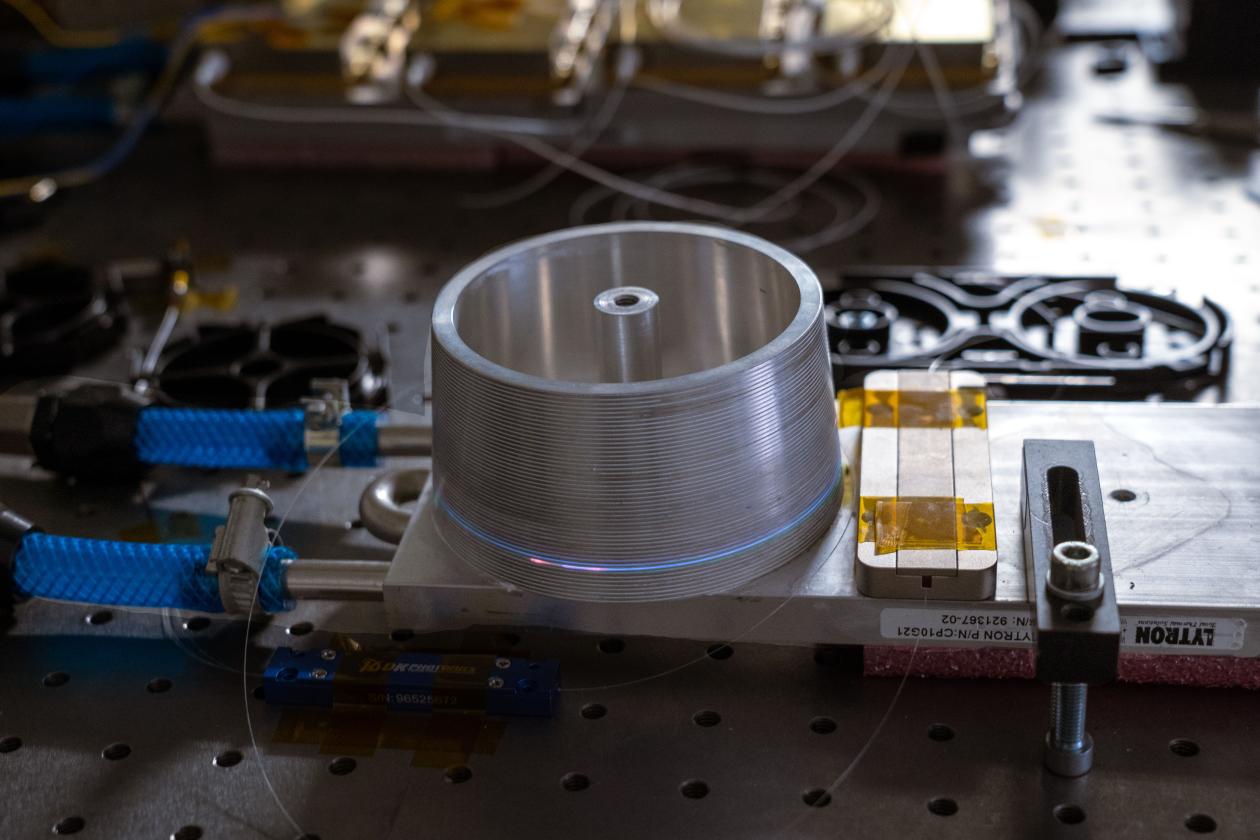
Together with five partners from two additional countries, LZH scientists are developing a robust laser system for space-based measurements. LiDAR (Light Detection and Ranging) systems use laser pulses to capture distances and velocities, but can also measure trace gases and aerosols. The laser system should be used to monitor the greenhouse gas carbon dioxide from space in the future. This data on concentrations and distributions can help to improve our understanding of human-induced climate change and track the impact of potential countermeasures.
Space-qualified LiDAR laser system
The new laser is based on a hybrid architecture. It combines the advantages of fiber-optic systems, which are compact, versatile, and low-maintenance, with those of free-space designs, which offer high potential for power scaling. To achieve this, the partners work with both fiber and solid-state amplifiers. This combined solution has lower complexity than conventional systems and will therefore significantly accelerate the development of the space LiDAR system.
European Independence in Space
As part of the project, the partners are improving the design of a pulsed thulium fiber amplifier for the near-infrared range at a wavelength of 2.05 µm. The objective is to build a fiber amplifier prototype with Technology Readiness Level (TRL) 6 using exclusively European components. To optimize the entire laser system for operation under space conditions, the partners first develop a potential concept for a future space mission. Building on this foundation, they develop the requirements for the associated LiDAR system, the optomechanical design of the laser system, and specially adapted high-power laser diodes that emit at a wavelength of 790 nm, which are required for operating the fiber amplifiers. This culminates in the demonstration of a robust fiber amplifier built with European components. Finally, this is integrated into a hybrid overall laser system.
LZH conducts space qualification testing
The LZH scientists are responsible for space qualification testing within the project. They will subject individual components as well as the developed fiber amplifier to vibration and shock, thermal cycling, and radiation testing. The fiber amplifier is scheduled to advance from the existing Technology Readiness Level (TRL) 4 to 6 within three years.
About HALLOA
Led by ONERA (Office national d'études et de recherches aérospatiales), a total of six research institutes and companies from three European countries are collaborating within the Hybrid Amplifier Laser for LIDAR OperAtions (HALLOA) project: Laboratoire de Métérorologie Dynamique, LZH, Keopsys Industries, Lumibird Photonics Italia Srl, and Erdyn Consultants SAS. The project is funded under the European Union's Horizon Europe research and innovation program under grant agreement No. 101189970. www.halloa-project.eu

Laser Zentrum Hannover e.V. (LZH)
As an independent, non-profit research institute, the Laser Zentrum Hannover e.V. (LZH) stands for innovative research, development, and consulting. Supported by the Lower Saxony Ministry of Economics, Transport and Building, the LZH is dedicated to selflessly promoting applied research in the field of photonics and laser technology. Founded in 1986, almost 200 employees are now working at the LZH.
The LZH offers solutions to current and future challenges with its smart photonics. Along the process chain, natural scientists and engineers work interdisciplinary together: from component development for specific laser systems or for quantum technologies to process developments for a wide variety of laser applications, for example for medical and agricultural technology or lightweight construction in the automotive sector. 18 successful spin-offs have emerged from the LZH to date. Thus, the LZH creates a strong transfer between fundamental science, application-oriented research, and industry - and uses light for innovation.